
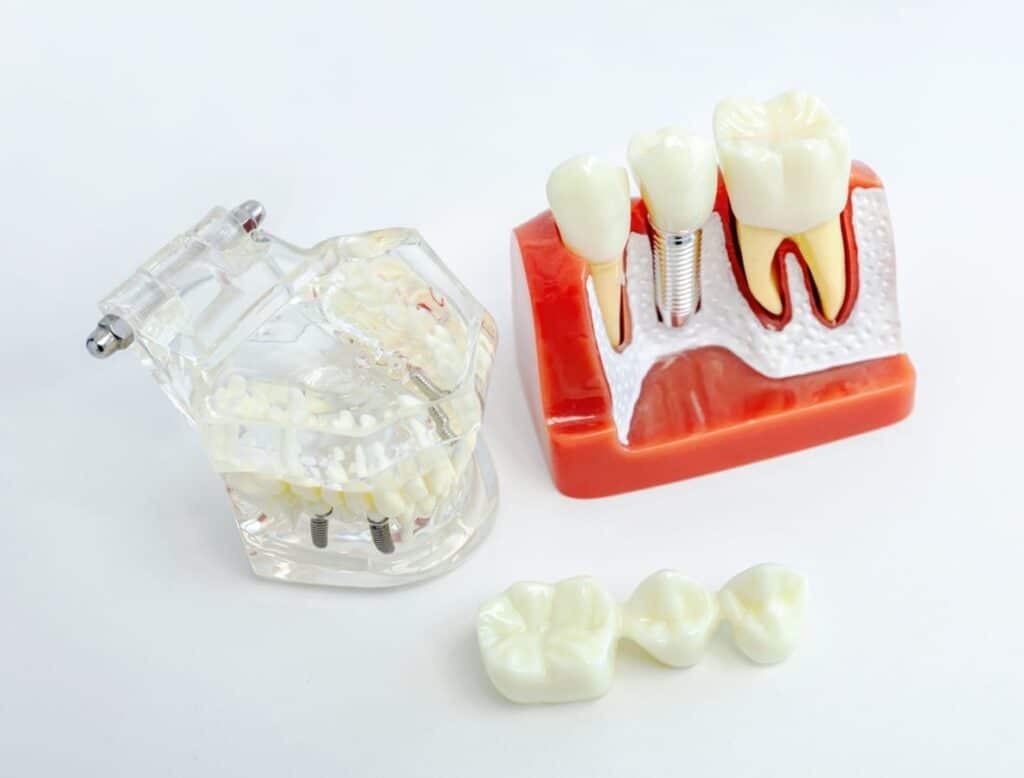
Losing a tooth changes more than just your smile. It affects how you eat, speak, and feel each day. If you are weighing dental implants vs dentures vs bridges in Carthage, NY, you are not alone. Many patients at Long Falls Dentistry face this exact decision. Dr. Zeeshan Salam helps patients understand which option truly lasts longest — and which one fits their lifestyle best.
Understanding Your Three Main Options in Carthage, NY
Before comparing longevity, it helps to understand what each option actually is. Each tooth replacement solution works differently inside your mouth.
Dental implants are titanium posts placed directly into your jawbone. They act as artificial tooth roots and support a permanent crown on top. They look and feel like natural teeth.
Dentures are removable appliances that replace multiple or all missing teeth. They rest on your gums and can be taken out for cleaning. Traditional dentures do not anchor into the bone.
Dental bridges are fixed prosthetics that span a gap between two remaining teeth. The bridge is cemented onto the healthy teeth on either side of the gap. They are not removable like dentures.
Dental Implants vs Dentures vs Bridges: Which Lasts Longest?
Longevity is one of the biggest factors patients in Carthage consider. The differences between these three options are significant over time.
Dental implants can last a lifetime with proper care. Studies show implants routinely last 20 to 30 years or more. The crown on top may need replacement after 10 to 15 years, but the implant post itself is extremely durable.
Dental bridges typically last between 10 and 15 years. They may need replacement sooner if the supporting teeth weaken. Regular check-ups help extend their lifespan significantly.
Dentures generally need replacement or relining every 5 to 8 years. As your jawbone changes shape over time, dentures can become loose and ill-fitting. This leads to additional adjustments and replacement costs.
- Implants: 20–30+ years (highest longevity)
- Bridges: 10–15 years (moderate longevity)
- Dentures: 5–8 years before relining or replacement
Which Option Best Suits Your Situation?
Longevity is important, but it is not the only factor. Your health, bone density, and the number of missing teeth all play a role in your best option.
Dental implants are ideal if you are missing one or a few teeth and have sufficient jawbone density. They require a minor surgical procedure and a healing period of several months. However, the long-term result is the closest thing to a natural tooth available today.
Bridges work well when you have healthy teeth on both sides of the gap. They are less invasive than implants and do not require surgery. The trade-off is that the supporting teeth must be shaved down slightly to hold the bridge in place.
Dentures are often the right choice when many or all teeth are missing. They are also typically more accessible from a cost perspective upfront. Modern dentures are more comfortable and realistic-looking than older versions.
- Choose implants if you want the most permanent, natural-feeling solution
- Choose bridges if you want a fixed option without surgery
- Choose dentures if you are missing most or all of your teeth
- Ask Dr. Salam about implant-supported dentures for a hybrid option
How Jawbone Health Affects Your Decision
One often-overlooked factor in this comparison is what happens to your jawbone after tooth loss. This is where implants truly stand apart from the alternatives.
When you lose a tooth, the jawbone beneath it begins to shrink. This process is called bone resorption. Without a tooth root stimulating the bone, the body slowly absorbs it over time.
Dental implants fuse with the jawbone through a process called osseointegration. This stimulates the bone just like a natural tooth root. As a result, implants actually help preserve your facial structure long-term.
Bridges and dentures do not address bone loss at all. Dentures can even accelerate bone resorption over time because of the pressure they place on the gums. This is a major reason why dentures often need frequent refitting as the years pass.
Other Treatments That May Work Alongside Tooth Replacement
Sometimes a tooth can be saved before replacement becomes necessary. Dr. Salam will always evaluate whether a tooth can be preserved first. A Root Canal treatment, for example, may save an infected tooth and eliminate the need for extraction entirely.
Additionally, patients exploring alignment concerns alongside tooth replacement may benefit from Invisalign to correct spacing issues before or after their restoration. Dr. Salam creates a complete treatment plan tailored to each patient’s unique needs.
The goal is always to give you the healthiest, most functional, and longest-lasting outcome possible. Every patient in Carthage deserves a solution that fits their life — not a one-size-fits-all answer.
Making Your Decision with Dr. Zeeshan Salam in Carthage
Choosing between dental implants, dentures, and bridges is a personal decision. There is no single right answer for every patient. The best choice depends on your oral health, jawbone condition, budget, and lifestyle goals.
At Long Falls Dentistry, Dr. Zeeshan Salam takes time to walk through every option clearly. He explains the pros, cons, and long-term outcomes in plain language. You will never feel rushed or pressured into a decision.
If you are ready to find out which tooth replacement option fits you best, our team in Carthage, NY is here to help. Book Now to schedule your appointment with our team.
Frequently Asked Questions
Are dental implants really worth the higher upfront cost?
Yes, for most patients, dental implants offer the best long-term value. They last 20 to 30 years or more with proper care, while dentures and bridges need replacement more frequently. When you factor in the cost of replacements and adjustments over time, implants often become the most cost-effective choice.
Can I get a dental implant if I have been missing a tooth for years?
Possibly, but bone loss may be a concern. When a tooth has been missing for a long time, the jawbone beneath it may have shrunk. Dr. Salam can evaluate your bone density and discuss whether a bone grafting procedure would make you a good implant candidate.
How do I care for each type of tooth replacement?
Implants are cared for just like natural teeth — brush, floss, and visit your dentist regularly. Bridges require special flossing tools to clean beneath the prosthetic. Dentures must be removed nightly, soaked in a cleaning solution, and kept moist to maintain their shape.
Is it painful to get a dental implant?
Most patients report less discomfort than expected. The procedure is performed under local anesthesia so you should not feel pain during placement. Post-procedure soreness is typically manageable and resolves within a few days.
What is an implant-supported denture?
An implant-supported denture combines the benefits of both options. A small number of implants are placed in the jaw and the denture snaps onto them securely. This eliminates slipping, improves chewing ability, and helps preserve jawbone — making it an excellent option for patients missing many teeth.